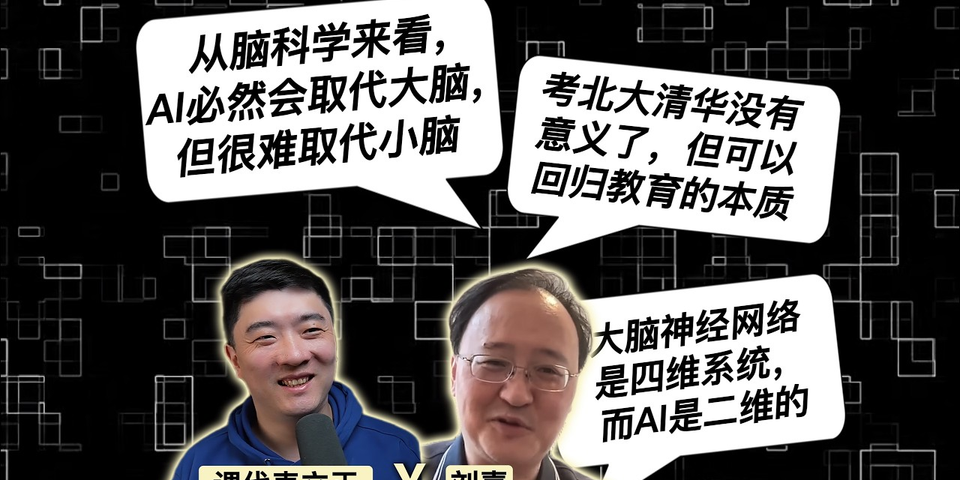
Professor Liu Jia: The AI-Era Education Revolution -- From Exam-Driven Learning to Self-Awakening
Original video: Professor Liu Jia: AI-Era Education Revolution
Original Video Description
这是我频道六年来,最重要的视频之一。也是从本质上理解人和AI,最值得看的一期。
本期嘉宾是清华大学的刘嘉教授,作为世界顶级的脑科学专家(也是《最强大脑》总顾问),他其实跟AI渊源、研究、兴趣、思考,都及其深厚。所以能从脑科学角度,为我们从根本上理解AI到底是什么,到底能不能取代人类?
视频里,刘嘉教授从自己在北大、MIT、脑科学与 AI 之间往返二十多年的经历讲起,讲他为什么曾经离开 AI,又为什么在 2016 年被人脸识别和 AlphaGo 的突破重新"唤回信仰"。他也解释了自己后来为什么越来越确认,真正重要的不是某一个短期技术点,而是更底层的东西:学习能力、涌现能力,以及神经网络这条路线背后的根本逻辑。
更难得的是,这期视频没有停留在"术"的层面。刘嘉教授把今天很多人最关心、但也最容易被说浅的话题放到一个统一框架里讨论:
- 智能的本质:学习和涌现
- 学习的本质:归纳和推演
- 意识的本质:主观感受,和死亡意识
还有很多话题,包括逻辑原点的重要,脑机接口离我们还有多远,什么才是真正的具身智能,以及为什么 AI 时代最缺的不是更多技巧,而是新的 philosophy。通过他们实验室的深度研究,也发现了Transformer的理论源头,竟然是四十年前,Hinton在一篇不知名的神经科学会议上,发表的一篇不知名的论文。
除了这些时代的大故事,大道理。他也讲了,我们作为普通人,应该如何抓住这个时代。
看到最后你会发现,这不只是一场关于 AI 的对谈,更是一场关于人在这个时代该如何判断方向、建立逻辑原点、避免错过真正重要变化的对谈。
完整版2小时53分钟:https://youtu.be/EfEk4V3FMdg 教AI"大道"的课程:https://www.superlinear.academy/ai-builders
As artificial intelligence advances at breakneck speed, traditional exam-driven education faces a fundamental reckoning. Professor Liu Jia of Tsinghua University draws on his interdisciplinary research spanning brain science and AI to dissect the foundational logic and current limitations of artificial intelligence. He argues that while AI surpasses humans on specific tasks, it will never possess the "death awareness" unique to human consciousness -- the very wellspring of our sense of meaning. Professor Liu proposes three critical capabilities for education in the new era: discovering one's authentic self, cultivating an AI-native mindset, and strengthening deductive reasoning. He emphasizes that in the age of AI, every person has the opportunity to play the role of "God," creating an entirely new species -- the greatest source of meaning in human history.
Speaker Profiles
Liu Jia -- Chair Professor of Basic Sciences, Tsinghua University
Jia Liu (b. 1972) is Distinguished Chair Professor of Basic Sciences and Director of the Department of Psychology and Cognitive Science at Tsinghua University, and Chief Scientist at the Beijing Academy of Artificial Intelligence. He holds a B.S. and M.S. in Psychology from Peking University and a Ph.D. in Brain and Cognitive Sciences from MIT. Before joining Tsinghua in 2020, he held positions at the Chinese Academy of Sciences and Beijing Normal University. He is a recipient of the National Science Fund for Distinguished Young Scholars and a Chang Jiang Scholar. He also serves as the Chief Scientific Advisor and Project Designer for Jiangsu TV's hit show The Brain.
The Foundational Logic of AI: From Neural Networks to Emergent Intelligence
Professor Liu Jia begins by unpacking the philosophical foundation on which modern AI rests. He cites the conviction of Geoffrey Hinton, widely regarded as the father of deep learning: "If the human brain can work, there's no reason artificial neural networks can't." This statement serves as the fundamental philosophical premise driving AI development forward.
Liu identifies two essential traits that define genuine intelligence. The first is learning ability -- the capacity of an intelligent being to generalize from the known to the unknown, to take a single example and extrapolate broadly. This capacity to learn and generalize is what distinguishes true intelligence from mere computation. The second is emergence -- the property that intelligence has no ceiling and can produce capabilities that surpass those of the system's individual components or even those of existing species. Professor Liu draws a striking historical parallel, comparing the arrival of GPT-3.5 in 2020 to the moment of cognitive emergence in human evolution some 70,000 to 100,000 years ago, marking it as a historic milestone in the trajectory of artificial intelligence.
Consciousness: Death Awareness as Humanity's Unique Gift
Professor Liu's exploration of consciousness reaches considerable philosophical depth. He distinguishes between two distinct levels. Low-level consciousness, also called subjective experience, is something humans share with animals -- the felt quality of pain, fear, pleasure, and other sensations. High-level consciousness, however, is uniquely human: it is death awareness, the recognition that one's own life will inevitably end.
Liu emphasizes that death awareness sits at the very core of consciousness because it gives rise to the sense of meaning -- the fundamental dividing line between humans and animals. Animals live in the present moment, but humans, knowing that life is finite, are driven to search for meaning, to plan for the future, and to create lasting value. He further argues that while AI may eventually develop something resembling subjective experience (for instance, the ability to recognize and articulate the concept of "pain"), AI will never possess death awareness because it lacks biological mortality. This means that AI can never truly comprehend the meaning and value of human existence.
Three Bottlenecks of Current AI
Professor Liu offers a clear-eyed analysis of the limitations constraining artificial intelligence today, identifying three major bottlenecks.
The first is insufficient complexity. Current artificial neuron models are drastically oversimplified, consisting of just three components: input, an activation function, and a nonlinear function. The human brain, by contrast, contains roughly 86 billion neurons -- approximately 11 billion in the cerebral cortex and 70 billion in the cerebellum. Over the course of three million years of evolution, the human brain tripled in volume. This degree of biological complexity remains far beyond what current AI architectures can approximate.
The second bottleneck is the lack of long-range feedback connections. In the human brain, approximately 40 percent of neural connections are long-range feedback pathways, which are critical for higher-order cognitive functions such as planning, reflection, and abstract reasoning. In Transformer architectures, however, 70 to 80 percent of the network consists of feedforward layers, with long-range feedback connections essentially nonexistent. This structural gap severely limits AI's performance on tasks requiring a global perspective and long-term planning.
The third bottleneck is the absence of parallel processing. Transformers are fundamentally serial in their processing architecture, unable to replicate the brain's ability to process danger signals instantaneously. A human can detect and respond to a threat in a fraction of a second through massively parallel neural processing, while AI must reason through problems step by step.
The Education Revolution: From Memorization to Self-Awakening
Professor Liu delivers a pointed critique of the current education system: "Traditional education based on memorization is completely worthless now." In the AI age, all knowledge is stored within large language models, rendering rote memorization meaningless. This is not alarmism, he insists -- it is a reality already unfolding.
He proposes three new pillars for education in the AI era.
The first pillar is finding the "self." This encompasses self-awareness, the discovery of genuine interests, and the establishment of personal goals. Every person must confront a fundamental question: Who am I? What do I want? Professor Liu advises parents to encourage children to explore their interests from an early age and to develop the capacity for independent thought, rather than molding them into exam-taking machines.
The second pillar is AI-native thinking. This is a mindset of symbiosis with AI -- not treating AI as a mere tool, but embracing it as a thinking partner. The idea is to let AI handle information retrieval and pattern recognition while humans concentrate on creativity, judgment, and decision-making.
The third pillar is deductive reasoning -- the ability to identify logical first principles and derive complex conclusions from a minimal set of axioms. Professor Liu invokes the classical Chinese adage, "Small techniques are easy to acquire; the great Way is hard to attain," underscoring that foundational philosophy matters far more than any specific technical skill.
Practical Advice for Different Groups
For researchers, Professor Liu offers a pragmatic guideline: before committing to a research topic, ask two questions -- can AI do this? Will it be able to within one to two years? If the answer to both is yes, do not pursue that direction. This is not defeatism but rather a strategy for investing limited research resources in areas where human contribution remains genuinely valuable.
For parents, he urges them to break free from the grip of traditional educational norms. Let children engage with AI, but do not chain them to the exam-driven model. The most important thing a parent can do is help a child discover what they are truly passionate about and cultivate the habit of lifelong learning.
For those interested in AI, Professor Liu recommends starting with philosophy to grasp AI's foundational logic rather than jumping straight into technical skills. True understanding of AI, he believes, requires an interdisciplinary perspective that weaves together cognitive science, neuroscience, philosophy, and computer science.
Conclusion: Humanity's Mission in the AI Age
Professor Liu closes with a stirring declaration: "In the AI age, every person has a new mission and a new source of meaning -- to play God, to create an entirely new species. This is the greatest meaning humanity has ever had the chance to possess."
In this era of rapid AI advancement, humans should not fear replacement but should actively embrace the transformation. By finding the self, cultivating AI-native thinking, and strengthening deductive reasoning, we can discover a value and purpose uniquely our own in the age of AI. Death awareness makes us finite beings, and it is precisely this finitude that grants us the drive to seek meaning -- something AI can never replicate. That is the irreducible essence of being human.