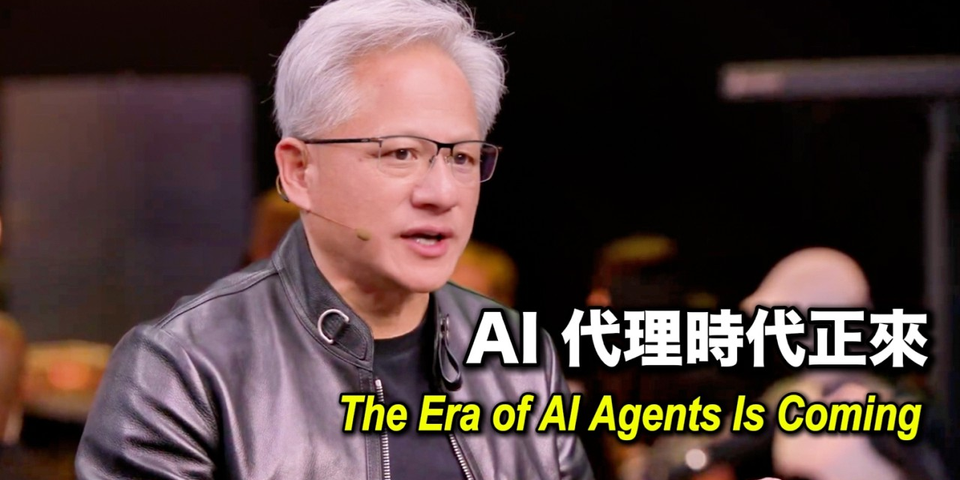
Jensen Huang Interview: The Era of AI Agents Is Coming — NVIDIA Strategy, Compute Architecture, and Future Predictions
Original video: Jensen Huang: The Era of AI Agents Is Coming
Original Video Description
In this major new interview, Jensen Huang breaks down AI agents, open models, robotics, autonomous driving, healthcare AI, space data centers, and how AI will reshape global industries. Jensen Huang says every engineer may soon work with hundreds of AI agents, while robots could rapidly move from factories into homes and daily life within just a few years. The most striking part of this interview is not just the tech — it is how human work and everyday living are being redefined.
Credits: All-In Podcast https://www.youtube.com/watch?v=gwW8GKwHB3I
NVIDIA CEO Jensen Huang sat down for an extensive interview covering his comprehensive vision for the AI industry. He argues that AI is undergoing a major paradigm shift — from generative to reasoning to agentic — with compute demand growing 10,000x in just two years. NVIDIA has transformed from a traditional GPU company into an AI factory company, launching its core operating system Dynamo. Huang predicts the physical AI market will reach $50 trillion, with robots becoming ubiquitous in 3-5 years and digital biology hitting an inflection point within five years. He also calls for avoiding AI doomsday narratives, emphasizes that open-source and closed models will coexist, and advises young people to specialize deeply in vertical domains while leveraging AI tools.
Speaker Profiles
Jensen Huang — Founder & CEO, NVIDIA (Guest)
Jensen Huang (b. 1963, Tainan, Taiwan) moved to the United States at age 9. He earned a BSEE from Oregon State University and an MSEE from Stanford University, and worked at LSI Logic and AMD before co-founding NVIDIA in 1993 at a Denny's restaurant with Chris Malachowsky and Curtis Priem. Under his leadership, NVIDIA evolved from a gaming GPU company into the dominant AI computing infrastructure provider, with 43,000 employees (38,000 of them engineers) and projected annual revenue exceeding $350 billion. He has been named the world's best CEO by Fortune, The Economist, and Brand Finance, and was included in TIME's 100 most influential people.
Brad Feld — Partner, Foundry (Host)
Brad Feld is a prominent venture capitalist, author, and partner at Foundry (formerly Foundry Group), as well as co-founder of Techstars, one of the world's leading startup accelerators. He co-founded Foundry Group in 2007, managing multiple $225 million early-stage funds. He was an early investor in Harmonix, Zynga, MakerBot, and Fitbit, and has long been a prominent voice in the startup ecosystem.
NVIDIA's Strategic Transformation: From GPU Company to AI Factory
Dynamo: The Foundation of the Next Industrial Revolution
In this interview, Huang reveals NVIDIA's biggest strategic shift over the past year: the formal evolution from a traditional GPU company to an "AI factory company." This transformation was publicly disclosed two and a half years ahead of schedule at the GTC conference, demonstrating a highly transparent and forward-looking communication strategy.
NVIDIA's core operating system is named Dynamo, after the generator (dynamo) invented by Siemens — symbolizing the coming next industrial revolution. The foundational technology is called "disaggregated inference," representing a fundamental innovation in AI compute architecture.
Huang further explains that NVIDIA acquired Groq (an AI inference chip company focused on LPUs) and recommends that enterprises allocate 25% of their data center space to a Groq LPU and GPU combination. He stresses that factory price should not be directly compared to token cost, because a $50 billion factory can produce tokens at the lowest possible cost.
Revenue Projections and Market Position
Several data points from the interview underscore NVIDIA's dominance in the AI market:
- Projected annual revenue: over $350 billion
- Free cash flow: $200 billion
- Quarterly data center revenue: $25 billion
- Blackwell + Vera Rubin order visibility: $1 trillion
- US data center market share: 95% (China share dropped from 95% to 0%)
These figures reflect the explosive growth in AI infrastructure demand and validate Huang's optimistic outlook on the industry.
The Inference Paradigm Shift: From 100x to 10,000x
Reasoning Compute: The Most Complex Problem in the World
Huang puts forward a striking claim: reasoning compute is the most complex computational problem in the world today. He outlines three stages of AI development and their compute requirements:
- Generative AI to reasoning AI: 100x increase in compute demand
- Reasoning to agentic AI: another 100x increase
- Total growth: 10,000x in two years
This means AI systems are evolving from simple content generation to intelligent systems requiring complex reasoning, and then to AI agents capable of autonomously executing multi-step tasks — each step requiring exponentially more compute resources.
The Evolution of Inference Scaling Laws
Huang uses a vivid analogy to illustrate the evolution of inference scaling laws: previously, we talked about 1,000x growth, but now the target is 1 million or even 1 billion times the inference compute capacity. This geometric growth reflects a core shift in AI systems — from "answering questions" to "solving problems."
He further notes that this explosive growth in compute demand poses unprecedented challenges for hardware, software, networking, and system architecture — and is the primary reason NVIDIA is investing heavily in the Dynamo operating system and disaggregated inference technology.
Three Computer Architectures: The AI-Era Compute Blueprint
Huang outlines three core computing systems for the AI era, a framework that helps explain NVIDIA's comprehensive positioning:
Training Computer
Infrastructure for training AI models, with flagship products including the H100 and B200 series. These systems process massive datasets and complex neural network architectures and are the engine behind AI capabilities.
Simulation Computer
Centered on NVIDIA Omniverse, these virtual environments are primarily used to evaluate and train robots. This "digital twin" technology allows robots to learn and optimize behavior in highly realistic virtual worlds before being deployed in real applications.
Edge Computer / Robot Computer
Computing systems designed for autonomous vehicles, robotics, and embedded applications. Huang mentions an intriguing application scenario: future robots may come in many forms, from industrial robotic arms to companion robots like "teddy bears" — demonstrating a rich imagination for robotics use cases.
Together, these three computer architectures form NVIDIA's complete AI compute ecosystem, spanning from cloud-based training to edge inference.
The Four Pillars of AI Agents
Core Components of Agentic AI
Huang breaks down AI agents into four key elements:
- Memory: Agents need both long-term and short-term memory, learning from past interactions and retaining context
- Resources: Agents must access and leverage various tools, databases, and external services
- Scheduling: Agents can plan and coordinate the execution order and priorities of multi-step tasks
- Skills: Agents possess specialized capabilities for specific tasks and can apply them flexibly across different scenarios
The integration of these elements enables AI agents to perform complex, multi-step work — from helping engineers write code to autonomously conducting research.
NVIDIA's Internal Experiment: 7 Years of Research in 30 Minutes
Huang shares a striking internal case study: NVIDIA engineers used an Auto Research tool to complete PhD-level research in just 30 minutes — work that would normally take 7 years. This vividly demonstrates the revolutionary impact AI agents will have on knowledge workers.
He also mentions another case: a software team replaced and deployed an entire software stack on a Sunday evening in just 90 minutes, showcasing the efficiency potential of software development in the AI era.
The Token Consumption Benchmark for Engineers
Huang proposes a bold productivity metric: "A 250K in tokens would worry me." This perspective directly ties AI usage to engineer output value, foreshadowing a future where engineers will have 100 AI agents working alongside them simultaneously.
Open Source vs. Closed Models: Coexistence, Not Competition
A Dual-Track Industry Landscape
On the trajectory of the AI model market, Huang states his position clearly:
"Models are technology, not products. For most consumers, closed model services like ChatGPT, Claude, and Gemini will continue to thrive. But industry-specific expertise must be controlled and customized through open-source models."
He emphasizes that open-source and closed models have an "A and B" relationship, not "A or B." Closed model services will continue to meet everyday consumer needs, while open-source models are the critical tool for enterprises and specific industries to build competitive advantage.
Every Company Will Become an AI Value-Added Reseller
Huang predicts: "Every enterprise software company will become an AI value-added reseller." This means businesses across all industries will develop customized AI solutions built on open-source models, tailored to their domain expertise — from medical diagnostics to financial risk assessment, AI will deeply penetrate every sector.
Physical AI and Robotics: The $50 Trillion Revolution
Physical AI: The Next Great Industry
Huang defines physical AI as "the greatest prosperity unlocker of all time." Key data points:
- Physical AI market size: $50 trillion
- Current physical AI revenue: approximately $10 billion/year
- Robots becoming ubiquitous: 3-5 years
He elaborates: "The technology development from high-functioning proof of concept to reasonable product never takes more than two or three cycles. In about 3 to 5 years, robots will be everywhere."
Robotics Supply Chain: China's Advantages and Challenges
On the robotics supply chain, Huang points out that China has significant advantages, particularly in micro-electronics, motors, rare earth materials, and magnets — key raw materials and components. This observation also reflects his concern about geopolitical risks.
He calls on the United States to expand global diffusion of AI technology, avoiding the mistakes made in the solar and rare earth industries from being repeated in AI.
Autonomous Vehicle Strategy: The Android Model
Huang reveals that NVIDIA's autonomous vehicle strategy follows an open model similar to Android, with partners including BYD, Mercedes-Benz, and Uber. This strategy allows multiple automakers to use NVIDIA's AI compute platform while maintaining differentiation in their own brands and software.
Digital Biology: Healthcare's ChatGPT Moment
The Inflection Point in 5 Years
Huang is highly confident about AI applications in healthcare:
"We are at the ChatGPT moment for digital biology. In 5 years, I fully believe the healthcare industry will reach the inflection point for digital biology."
He identifies three primary application areas:
- Drug Discovery: AI accelerates candidate drug screening and research, dramatically shortening new drug development cycles
- Agentic AI Diagnosis: AI diagnostic systems capable of multi-step reasoning
- Da Vinci Surgical Robot: AI-powered precision surgical systems
These use cases demonstrate the enormous potential of combining AI with healthcare — not only improving diagnostic accuracy but also extending medical services to remote areas.
Geopolitics and Supply Chain Management
The China Market Upheaval
The interview reveals that NVIDIA's share of the Chinese market dropped from 95% to 0%, reflecting the far-reaching impact of export control policies on the tech industry. Huang stresses the importance of rebuilding supply chains, calling for diversified supply systems in Taiwan, the Middle East, Israel, and beyond.
AI Diffusion Policy Recommendations
Huang offers clear policy recommendations:
"Warnings are good, fear is not necessary."
He urges policymakers to adopt a proactive rather than reactive stance, supporting global diffusion of AI technology while establishing appropriate regulatory frameworks. This position aligns with his criticism of AI doomsday narratives, emphasizing humanity's agency over the direction of AI development.
Advice for Founders and Young People
The Founder's Moat: Deep Specialization
For founders, Huang's core advice is deep specialization:
"Know your vertical deeper than anyone, better than anyone. Get your agents connected to your customers as fast as possible — the flywheel will make your agents better."
He emphasizes that in the AI era, deep domain expertise in a vertical is a competitive advantage that cannot be quickly replicated. Founders should focus on a specific industry, build deep domain knowledge, and then use AI agent tools to amplify their output value.
A Survival Guide for Young People
For young people, Huang offers three specific recommendations:
- Become an AI power user: Proficiency with AI tools is a baseline skill
- Prioritize language skills: "English major might be the most successful"
- Avoid over-prescribing rules: Give AI enough creative space; do not constrain its potential with too many rules
A Pragmatic View on Work Transformation
On AI's impact on employment, Huang takes a pragmatic stance: "Some jobs will disappear, but more new jobs will be created." He emphasizes that AI is not meant to replace humans but to augment human capabilities, enabling us to take on more creative and valuable tasks.
Conclusion: Opportunities and Outlook in the AI Agent Era
This interview showcases Jensen Huang's comprehensive vision for AI development, with the following core takeaways:
- Compute demand explosion: AI inference compute has grown 10,000x in two years, with a clear trajectory from generative to reasoning to agentic AI
- NVIDIA's transformation: From GPU company to AI factory company, offering a complete three-tier computer architecture
- Dual-track coexistence: Open-source and closed models will coexist long-term, each serving different use cases
- Physical AI rising: Robots everywhere in 3-5 years, with a $50 trillion market about to explode
- Digital biology: Healthcare will reach its digital biology inflection point within 5 years
- Geopolitical warning: A call to expand global AI technology diffusion and avoid over-concentration of supply chains
In closing, Huang emphasizes the importance of humility — despite his enormous success, he still considers himself "just a software guy." He urges society to avoid excessive AI doomsday narratives, reminding us that humanity retains agency over how AI is deployed, and should actively embrace the opportunities this technological revolution brings.
The tech leader whom the host calls "the guardian we need" is steering NVIDIA to play the role of core infrastructure provider in the AI era. His foresight and strategy will profoundly shape the direction of the tech industry over the next decade.