How to Speak: Patrick Winston's Complete Guide to Communication
Original video: How to Speak
Original Video Description
MIT How to Speak, IAP 2018 Instructor: Patrick Winston View the complete course: https://ocw.mit.edu/how_to_speak
Patrick Winston's How to Speak talk has been an MIT tradition for over 40 years. Offered every January, the talk is intended to improve your public speaking ability in critical situations by teaching you a few heuristic rules.
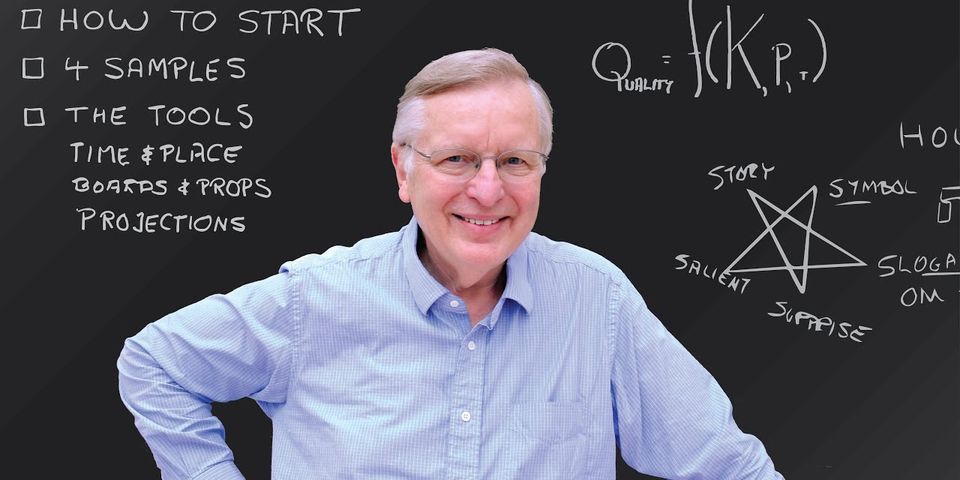
This is MIT AI professor Patrick Winston's classic "How to Speak" lecture. He argues that communication is a skill that can be systematically learned through knowledge and practice, not talent. Winston proposes a "communication formula": Quality = Knowledge + Practice + Talent, where talent matters least. He shares four core speaking techniques -- cycling, building a fence, verbal punctuation, and questioning -- alongside detailed guidance on using blackboards versus slides. The talk also covers the 5-minute rule for job talks, how to inspire students, and the "Winston Star" framework for making your research memorable.
Speaker Profile
Patrick Henry Winston (1943-2019) -- Professor, MIT CSAIL
Patrick Winston was a professor at MIT's Computer Science and Artificial Intelligence Laboratory (CSAIL). Born in 1943, he earned his BS (1965), SM (1967), and PhD (1970) at MIT, studying under AI pioneer Marvin Minsky. He served as director of the MIT Artificial Intelligence Laboratory for 25 years (1972-1997), with research focused on machine learning and human intelligence. In his later years, he led the Genesis Group exploring AI systems capable of story understanding. Winston taught AI courses at MIT for decades and received multiple teaching awards including the Baker Award. His "How to Speak" lecture, held every January since the 1970s, became one of MIT's most popular traditions, influencing countless students and professionals. Professor Winston passed away in July 2019 at the age of 76.
Why Speaking Matters: Communication Determines Career Success
Without Communication Skills, Don't Enter the Battlefield
Winston opens with a powerful analogy: military law forbids officers from sending soldiers into battle without weapons, because it would be sending them to their deaths. Similarly, he argues, sending students into the workplace without communication skills is equally irresponsible.
This reveals an important workplace reality: no matter how deep your expertise, if you cannot effectively convey your ideas, your value is severely diminished.
The Priority Order of Success Factors
Winston ranks the three core abilities that influence success:
- Speaking: Ranked first as the most directly effective form of communication
- Writing: Important, but less impactful than oral expression
- Quality of ideas: Even the most valuable ideas cannot create impact if they cannot be communicated
This ranking challenges the common belief that "expertise matters most." In reality, even brilliant ideas are invisible if you cannot articulate them clearly.
The Communication Formula: Balancing Knowledge, Practice, and Talent
Three Factors That Determine Communication Quality
Winston offers a concise and powerful formula:
Communication Quality = Knowledge + Practice + Talent
He emphasizes that in this formula, talent (T) has the smallest impact. What truly matters is how much you know and how much time you invest in practice.
The Skiing Story: Talent Isn't Everything
Winston shares a personal experience to prove this point. While skiing at Sun Valley, he encountered Mary Lou Retton, an Olympic medal-winning gymnast. To his surprise, despite her extraordinary athletic talent, her skiing was worse than his.
This vividly illustrates that even when someone possesses exceptional talent in one domain, you can still outperform them in practice through superior knowledge and more practice. This is deeply encouraging for anyone who believes they "lack talent."
The Art of Opening: How to Capture Your Audience's Attention
Never Start with a Joke
Winston's first piece of advice may surprise many: do not open your talk with a joke.
The reason is simple: when the audience first enters the room, they're not mentally ready. They may be thinking about their last meeting, tonight's plans, or still settling into their seats. A joke delivered at this moment typically falls flat, resulting in awkward silence.
The Empowerment Promise: Tell the Audience What They'll Gain
So how should you begin? Winston recommends an "Empowerment Promise" -- clearly telling the audience what they will know by the end of the talk that they didn't know before.
This approach immediately creates expectations, letting the audience know their time investment will pay off. A good empowerment promise should be specific, clear, and convey tangible value.
Four Core Speaking Techniques
Cycling: Say It Three Times
Cycling is one of Winston's most emphasized techniques. The core concept: repeat your key message three times.
Here's how:
- First time: Tell the audience what you're going to say
- Second time: Explain the content in detail
- Third time: Reinforce what you've said
Why three times? Research shows that roughly 20% of the audience will "zone out" during any given moment -- not because your content is boring, but because human attention naturally fluctuates. By repeating three times, you ensure most listeners receive the complete message at least once.
Building a Fence: Protect Your Ideas
The fence technique means clearly distinguishing your ideas from similar ones proposed by others.
When you present an insight, others may have proposed something similar. The fence technique helps you:
- Clearly mark what is your unique contribution
- Acknowledge related work while explaining how yours differs
- Help the audience distinguish "this is someone else's idea" from "this is my idea"
This approach demonstrates intellectual integrity while making your ideas more distinct and memorable.
Verbal Punctuation: Help the Audience Navigate
A talk is a time-based medium -- the audience cannot "go back and re-read." Verbal punctuation provides signposts that tell the audience:
- Which point we're currently on
- That this section is about to end
- That we're about to move to a new topic
Specific techniques include:
- Numbering items ("first, second, third")
- Using transition phrases ("besides this, we also need to consider another factor")
- Explicitly marking section changes ("let's return to our initial question")
These techniques help lost listeners find their way back and make the entire talk more structured.
Questioning: Engage the Audience
Questioning is an effective way to stimulate audience participation, but Winston offers key principles:
- Wait time: After posing a question, wait at least 7 seconds before continuing. This gives the audience time to think and allows bolder listeners to raise their hands.
- Difficulty level: Questions should be moderately difficult. Too easy feels insulting; too hard discourages participation.
- The power of silence: Silence is not awkward -- it's space for the audience to think.
Time and Place: Often Overlooked Critical Factors
Best Speaking Time: 11 AM
Based on his observations, Winston recommends scheduling talks around 11 AM. This time has several advantages:
- Most people are awake, past the morning grogginess
- It's not after lunch or dinner, avoiding post-meal drowsiness
- Most people can fully focus
The Art of Venue Selection
Venue conditions directly affect audience focus:
- Lighting: Always choose a well-lit venue. Dim lighting makes people drowsy -- a cardinal sin for speakers.
- Scouting (Casing): Visit the venue before your talk to check projection equipment, seating arrangements, whether there are stairs, and other details.
- Capacity: Seats don't need to be completely full, but ideally more than half full. A sparsely populated room makes both speaker and audience uncomfortable.
Blackboards vs. Slides: The Wisdom of Tool Selection
When to Use a Blackboard
Winston has a particular fondness for blackboards, believing they are especially effective in these scenarios:
- Teaching (Informing): When your purpose is to convey information and explain concepts
- Visual quality: Drawings on a blackboard are clearer and have more texture
- Speed matching: Writing speed matches the audience's absorption rate, giving them sufficient processing time
- Body language target: Hand movements have a clear focal point
He specifically mentions that the late MIT professor Seymour Papert was a master of blackboard teaching, demonstrating its unique appeal.
When to Use Slides
Slides are better suited for:
- Exposing ideas: When you want more people to encounter your research
- Academic presentations: When a large audience needs to quickly grasp key points
- Job talks: When time is limited and efficient communication is necessary
The Seven Deadly Sins of Slides
Winston outlines the "seven deadly sins" of slide presentations -- common mistakes speakers make:
- Too many words: The biggest problem. Winston's students experimented and found that when slides contain too much information, audiences tend to read the slides rather than listen to the speaker.
- Standing too far away: Don't stand too far from the screen, forcing the audience's gaze to ping-pong between you and the screen.
- Using a laser pointer: Laser pointers cause you to lose eye contact with the audience -- a huge loss.
- Font too small: Minimum recommended font size is 40-50pt, ensuring even the back row can read clearly.
- Too many bullet points: Each slide should have only a few key points.
- Color chaos: Maintain visual consistency and professionalism.
- Excessive animation: Over-the-top animations distract from the content.
Inspiring Students: A Teacher's Mission
Motivating Students at Different Levels
Winston shares findings from his survey on what inspires students:
- Advanced students: They are inspired by people who "help them see problems from new perspectives." They crave cognitive breakthroughs and growth.
- Freshmen: They are inspired by teachers who "tell them they can do it." They need confidence and encouragement.
The Common Key: Show Passion
Regardless of level, showing passion is the universal key to inspiring learning motivation. When a teacher is passionate about their research area, that emotion is contagious.
Winston believes that thinking is fundamentally a "storytelling" ability -- the ability to package complex concepts into a compelling narrative that keeps the audience engaged throughout.
Job Talks: Five Minutes to Make or Break
The 5-Minute Rule
In a job talk, you have only 5 minutes to prove your value. This conclusion comes from Winston's discussions with Professor Dolores Eder at the University of Colorado and Professor Bill Wulf at the University of Texas.
Two Things You Must Show
In those brief 5 minutes, you must demonstrate:
- Vision: What problem do others care about? What is your novel approach?
- Accomplishment: List the steps you've taken to solve this problem, showing you have the capability to complete it.
In short, you need to convince the interviewers in the shortest time possible that this is an important problem, and you have a unique method and ability to solve it.
The Winston Star: Making Your Research Memorable
Framework Overview
Winston developed a framework called the "Winston Star" to help researchers make their work more memorable. The five elements all start with S:
-
Symbol: Design a visual symbol related to your research that people immediately associate with your work.
-
Slogan: Create a concise, powerful phrase, such as "one-shot learning." Good slogans should be short and memorable.
-
Surprise: Share an unexpected finding or result that leaves a lasting impression on the audience.
-
Salient Idea: Make one idea "pop out" rather than stacking too many good ideas. Less is more -- focus is what gets remembered.
-
Story: Tell the story of how you completed this research and why this problem matters. A good story makes complex technology vivid and engaging.
The Bicycle Wheel Experiment: Verifying the Power of Knowledge
During the lecture, Winston demonstrates an interesting physics experiment: placing duct tape on a bicycle wheel and observing only the taped portion to determine the wheel's direction of rotation. This seemingly simple experiment actually tests whether you truly understand the underlying physics -- merely "knowing" isn't enough; you must be able to apply that knowledge.
How to End a Talk: Drawing the Perfect Conclusion
Never Say "Thank You"
Winston emphasizes that you should never end a talk by saying "thank you." This implies the audience stayed only out of politeness, diminishing the value of the entire talk.
Three Good Ways to End
-
Tell a joke: This is the advice of Winston's colleague Doug Lenat. A good joke sends the audience away with positive emotions.
-
Quote a political figure: Winston notes that politicians often use phrases like "God bless America" to end speeches, conveying a sense of gravitas.
-
Salute the audience: Acknowledge their time and participation, making them feel their presence was valued.
What Should Your Final Slide Say?
Many people's final slide reads "Conclusion," but Winston suggests using "Contributions" instead.
This small word change communicates an important message: your talk isn't "ending" -- it's "contributing" something valuable. This linguistic framing makes your talk more powerful and leaves the audience feeling they've gained something meaningful.