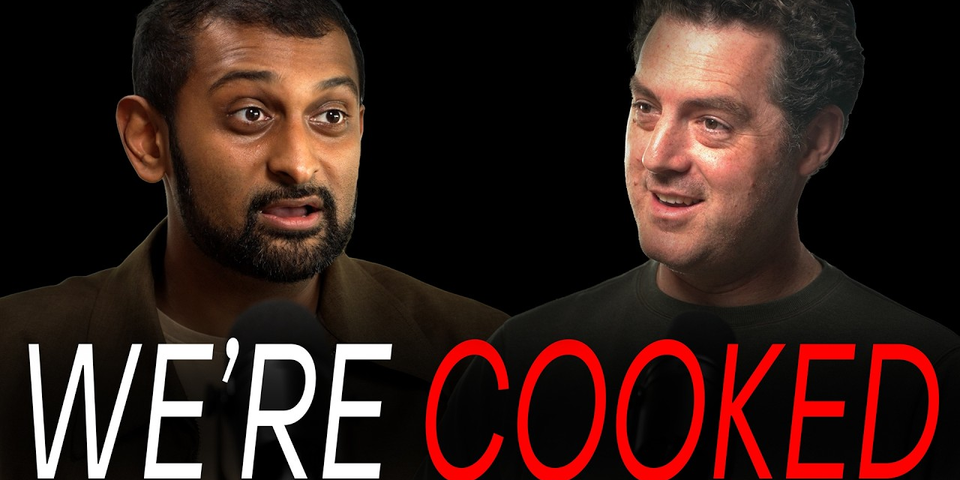
AI in War, Job Market Collapse, and the US-China Race: Dylan Patel's Deep Dive into the AI Industry
Original video: Dylan Patel: AI in War, Jobs are Cooked, Chinese Hacking, Microsoft Cope, and Super Intelligence
Original Video Description
Dylan Patel breaks down the current chaos inside the world's top AI companies. Dylan is the founder and CEO of SemiAnalysis, one of the best analyst firms covering everything AI and semiconductors.
Never miss an interview https://forwardfuture.ai
Download The 25 OpenClaw Use Cases eBook https://bit.ly/4aBQwo1
Download The Subtle Art of Not Being Replaced http://bit.ly/3WLNzdV
Download Humanities Last Prompt Engineering Guide https://bit.ly/4kFhajz
Discover The Best AI Tools https://tools.forwardfuture.ai
0:00 - Intro 1:13 - Dylan's predictions 7:47 - Anthropic vs DoW 15:08 - War Claude 22:00 - How happiness in society works 31:31 - Knowledge work is cooked 38:22 - Is SaaS dead? 45:18 - New Media landscape 48:16 - White collar bloodbath 52:38 - Open Source is Losing 1:04:45 - Chinese AI Distillation Attacks 1:09:52 - Closed Source VS Open Source 1:19:43 - Microsoft CEO is coping 1:26:55 - Who wins the ASI race?
My Links X: https://x.com/matthewberman Forward Future X: https://x.com/forwardfuture Instagram: https://www.instagram.com/matthewberman_ai TikTok: https://www.tiktok.com/@matthewberman_ai Spotify: https://open.spotify.com/show/6dBxDwxtHl1hpqHhfoXmy8
Media/Sponsorship Inquiries https://bit.ly/44TC45V
In this interview, prominent AI industry analyst Dylan Patel shares his deep insights on current AI development trends. Dylan argues that GPT 4.5's failure stems from insufficient data and overly complex infrastructure, while the junior software developer market has been "nuked," making it increasingly difficult for new graduates to find jobs. In the military AI domain, the US military's models lag behind China's by as much as six months, and that gap is widening rather than narrowing. Dylan also calls Microsoft's Copilot a "complete failure" and reveals that Microsoft has cancelled large portions of its OpenAI compute contracts. Facing the societal impact of AI, Dylan candidly shares that he has shifted from being a free-market capitalist to supporting UBI, because without it, society will tear itself apart. This interview covers the competitive landscape of the AI industry, the dramatic transformation of the job market, and the critical US-China AI gap.
Speaker Profiles
Dylan Patel -- Founder, CEO & Chief Analyst, SemiAnalysis (Guest)
Dylan Patel is the Founder, CEO, and Chief Analyst of SemiAnalysis, the preeminent authority on AI and semiconductors, founded in 2020. With over 50,000 Substack subscribers (the second-largest tech Substack globally), Dylan tracks the semiconductor supply chain and AI infrastructure buildout with unmatched granularity -- literally watching data centers get built via satellite imagery. Sam Altman has publicly referred to him as "that SemiAnalysis guy." X: @dylan522p
Matthew Berman -- CEO, Forward Future (Host)
Matthew Berman is the founder and CEO of Forward Future, one of the fastest-growing AI YouTube channels and newsletters. Before Forward Future, he founded Sonar Technologies, which he led for nine years until its acquisition in 2019. He was featured in Edelman's "AI Creators You Need to Know" list. X: @MatthewBerman
GPT 4.5's Failure and the AI Model Development Impasse
Dylan Patel opens the interview by reviewing his predictions from 18 months ago, noting that they have been fully validated. He identifies two primary reasons for GPT 4.5's failure: insufficient training data and overly complex infrastructure. GPT 4.5 currently cannot even be accessed via API, reflecting a genuine bottleneck in OpenAI's model development pipeline.
Dylan emphasizes that AI model progress is not linear -- it requires overcoming numerous engineering challenges at every step. Nevertheless, he maintains that pre-training and reinforcement learning (RL) scaling laws remain effective. The cost reductions have been staggering: equivalent-capability costs dropped roughly 1,000x last year and approximately 800x the year before that.
The Junior Developer Market Collapse and the AI Tools Revolution
A Devastated Job Market
Dylan states bluntly that the junior developer market has been "nuked." He uses Scale AI's acquisition as a case study, arguing that the company is "cooked" -- Meta acquired it for the talent, not the business, and Google is abandoning them. Finding a job as a new graduate has become significantly harder, and this represents the first wave of AI's impact on employment.
The Productivity Revolution from AI Tools
On the flip side, AI tools have delivered enormous productivity gains for non-programmers. The host shares his own experience: "Claude Code lets us move at 10x the speed of our competitors." He describes a striking example -- a hedge fund employee who had never written a line of code used Claude Code to build a tool that analyzes the tone of earnings call transcripts.
Dylan considers Claude Code the best agent system currently available. Its "skills" feature allows non-technical users to accomplish professional tasks by building reusable capabilities. He compares skills to KV cache blocks: the model can read, understand, and analyze to "augment" these skills over time, creating a competitive advantage that compounds through prompt engineering.
Anthropic vs OpenAI: The Defense Department Fallout and Corporate Positioning
Dario vs Sam -- A Clash of Philosophies
The interview delves into the divergence between Anthropic and OpenAI on defense policy. Dylan reveals that the government listed Anthropic as a supply chain risk, after which OpenAI moved in to sign the contract. He sees this as reflecting two fundamentally different corporate philosophies: Dario Amodei's principled stance versus Sam Altman's pragmatic opportunism.
AI Surveillance and Autonomous Weapons Controversy
Regarding Dario's response to the hypothetical question "if a nuclear strike is incoming, should AI be used to stop it," Dylan calls it "the dumbest response possible." He argues that Anthropic has become overly dogmatic on certain issues, causing it to fall behind OpenAI in government partnerships.
Revenue Projections
Dylan notes that Anthropic's cloud code spending has reached 60 trillion this year. He predicts that Anthropic's revenue could overtake OpenAI's as early as April 2025.
The US Military's AI Gap and the China Threat
The Model Gap in Military Applications
Dylan issues a stark warning: the US military is running an outdated version of Sonnet (v36) while China deploys the latest models. A six-month lag does not constitute an advantage, and what makes this even more concerning is that the gap is widening, not narrowing.
The Expanding US-China AI Divide
Dylan's analysis reveals that Q3/Q4 of last year represented the narrowest gap between US and Chinese AI models, but since then the gap has been growing. OpenAI now commands over 2 GW of compute resources, with Anthropic at approximately 1.5 GW. Just a year ago, OpenAI had only 600 MW -- the resource disparity is accelerating.
He further notes that DeepSeek V4 is unlikely to produce the same kind of market shock as R1, given the increasingly massive resource advantage held by US companies.
The Chinese Distillation Controversy and the Open Source War
Anthropic Accuses Chinese Companies of Distillation
Dylan discusses Anthropic's blog post alleging that Chinese companies have been distilling their models. He points to anomalous traffic volumes from Japan and South Korea originating from China, likely used for data distillation. He acknowledges that the "original sin" of the industry is training on web data, but emphasizes that capabilities derived from reinforcement learning are increasingly independent of web data.
He stresses that even small amounts of distilled data can significantly aid training, and that this data may be obtained indirectly through coding tools like Cursor and Lovable.
The Open Source vs Closed Source Battle
On the open source versus closed source debate, Dylan offers a nuanced perspective. By strict market share definitions, closed source models are gaining ground and open source adoption remains low. But by broader adoption metrics, open source is winning, as vast numbers of users run open source models. He specifically highlights OpenClaw's significant impact on local model deployment.
Microsoft's Strategic Failures and Industry Restructuring
Nadella's "Cope"
Dylan does not mince words in criticizing Microsoft CEO Satya Nadella's public statements as "cope." He reveals that Microsoft has cancelled large portions of its compute contracts with OpenAI, forcing OpenAI to turn to Oracle, SoftBank, Amazon, and Google for compute resources.
Copilot Is a Complete Failure
Dylan declares Microsoft's Copilot a "complete failure," clearly lagging behind in the AI era. Google and Amazon are dominating data center construction -- of the 100 GW in new capacity added over the past year, Google and Amazon account for half.
The Future of Software
Dylan predicts that SaaS will be displaced by agent systems, with value migrating to the infrastructure layer (Databricks, Snowflake, and similar platforms). He notes that "vibe coding" is on the rise, eliminating the need for traditional software development workflows. Claude Code represents the inflection point for agent systems -- the equivalent of the ChatGPT moment.
AI's Societal Impact and Economic Consequences
The White-Collar Bloodbath
Dylan uses the provocative phrase "white-collar bloodbath" to describe AI's impact on knowledge workers. He acknowledges there will be a painful adjustment period but believes new job opportunities will emerge in the long run.
The Capital-Labor Imbalance
Dylan provides a detailed analysis of capital's steadily growing share relative to labor, a trend that AI will only accelerate. He cites data showing that of the current 2% GDP growth, 1.7-1.8% is attributable to AI, yet only a narrow slice of the population benefits -- electricians, construction workers, semiconductor industry professionals, and capital allocators.
He makes the important observation that people's perception of their living standards has become disconnected from objective data, and this gap is one of the root causes of social unrest. The agricultural transition from 90% employment to less than 1% took a century; AI's impact, by contrast, is immediate.
The Decline of Traditional Media
Dylan notes that traditional outlets like CNBC now command audiences of only around 100,000 viewers. As content creation costs plummet, media markets are fragmenting. More than half of Americans hold negative views of AI, a reality the industry needs to take seriously.
UBI and the Future of Superintelligence
Dylan's Evolving Stance
Dylan shares his personal journey from free-market capitalist to UBI supporter. He states plainly: "I now think UBI is perfectly acceptable, otherwise society will tear apart." This represents a significant shift in his thinking, driven by his deep concern about the societal disruption AI will cause.
Who Will Reach ASI First?
At the close of the interview, Dylan is asked who will be the first to achieve ASI (Artificial Superintelligence). He notes that in his previous appearance he picked OpenAI, and he still picks OpenAI now. While Anthropic may soon surpass OpenAI in revenue, when it comes to ASI and recursive self-improvement, he believes the consensus points to Anthropic -- but at the time of this interview, his personal pick remains OpenAI.
The Limitations of Local Inference Hardware
Dylan also addresses local inference devices such as the DGX Spark, M5 Ultra, and RTX 5090, concluding that these are suitable only for hobbyists and enthusiasts. Running Kimi on a DGX Spark, for example, requires daisy-chaining 10 units, yields a low token-per-second rate, and costs tens of thousands of dollars in total -- making it commercially unviable. He emphasizes that compute resources will ultimately be allocated to the most efficient data-center-grade hardware.